Monday, October 12, 2026 5 min read IT Services
Why Building an Offender Management System In-House Is Not as Simple or Low Cost as It Seems
Discover why developing an offender management system in-house involves significant costs, security requirements, compliance challenges, and long-term maintenance considerations.
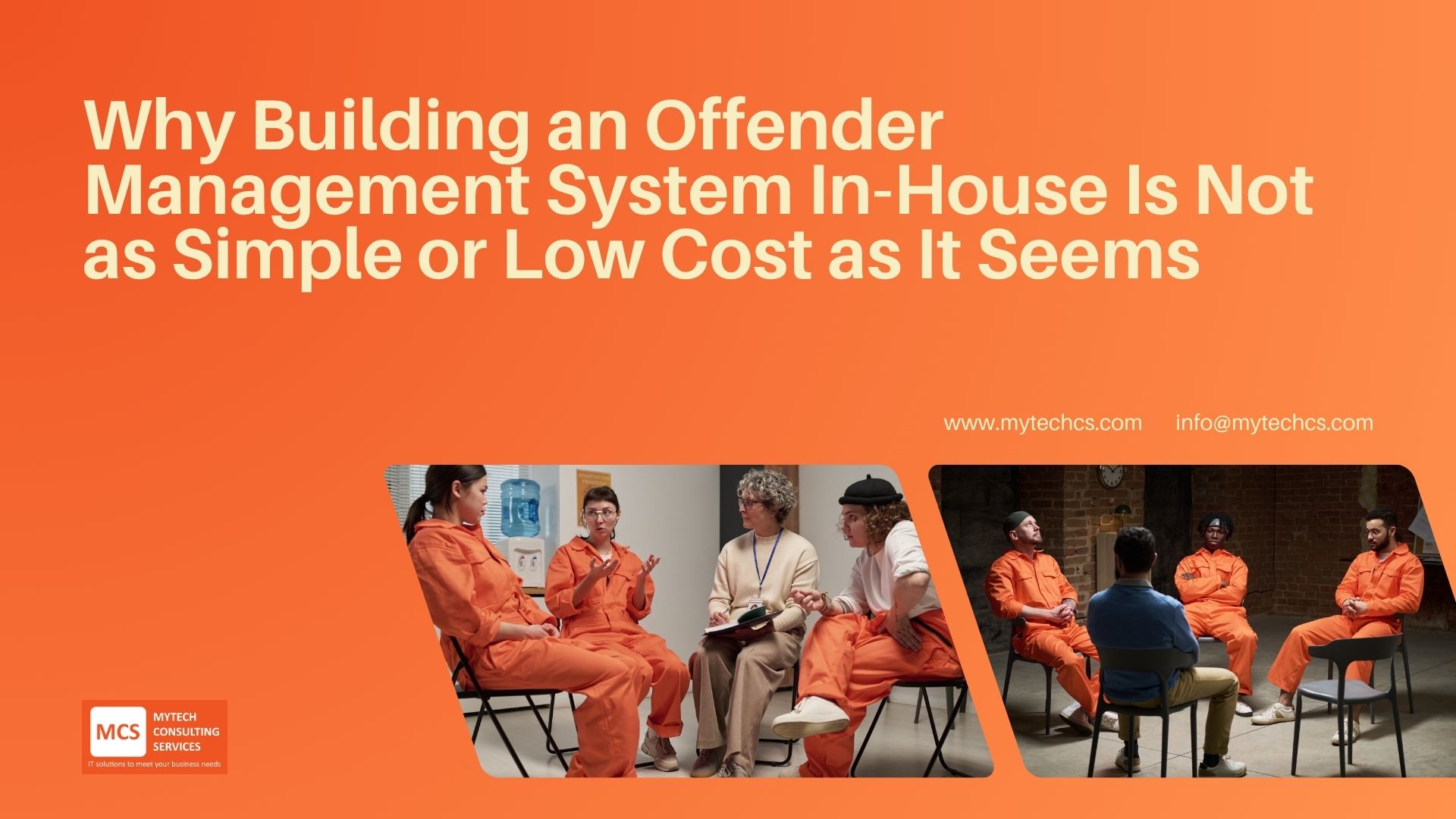
Building an Offender Management System in-house can look attractive at first. Agencies may expect lower costs, more control, easier customisation and less vendor dependency. However, an offender management system is not just another software project. It becomes the operational backbone for justice, corrections and community supervision teams.
The challenge is that in-house development often underestimates the complexity, security requirements and long-term responsibility involved. What starts as a database build can quickly become a multi-year product that must support policy changes, integrations, compliance reporting and secure inmate record management and data access controls.
What an Offender Management System Actually Has to Handle
An offender management system must do far more than store offender records. It may need to support intake, case management, sentencing information, custody and supervision, risk assessments, case plans, programs, appointments, release and re-entry, probation or parole activity, violations, alerts, reporting and analytics.
In other words, an Offender Management System (OMS) must represent a complex justice process that changes over time. This is why offender technologies need flexible workflows, strong data structures and operational knowledge built into the design.
Read more about what is an Offender Management System.
The Complexity of Criminal Justice Workflows
Different agencies and professionals may interact with the same person at different points in the justice journey. Responsibilities change based on legal status, sentence type, risk level, agency, jurisdiction and supervision model. An offender case management system therefore has to manage rules, exceptions and handoffs without creating gaps in accountability.
Integration Is a Major Challenge
An OMS rarely operates alone. It may need to exchange information with courts, law enforcement, corrections platforms, parole systems, electronic monitoring tools, identity systems, document platforms and other government databases. These integrations require APIs, data standards, identity matching, synchronisation, legacy system support, reliability and security.
Security and Privacy Requirements
Because an offender management system contains highly sensitive justice information, security cannot be treated as an afterthought. Agencies need authentication, role-based access, authorisation, audit trails, encryption, secure data exchange, backup and recovery, retention controls, monitoring and incident response.
This is where in-house builds become risky. Building the software also means accepting full responsibility for protecting the data, maintaining compliance and proving that access controls work as intended.
Reporting and Analytics Are More Difficult Than Expected
An OMS must often generate management reports, compliance reports, court-related information, caseload views, performance indicators, program outcomes and historical audit records. As laws, policies and operational priorities change, reporting requirements also change. This means the platform must continually evolve.
The Real Cost of Building In-House
The initial development budget does not show the full cost of ownership. Agencies must fund developers, analysts, UX design, project management, testing, hosting, databases, storage, networking, security infrastructure, bug fixes, patches, new features, regulatory updates, support staff and product ownership.
This is why offender management system reviews should look beyond launch costs. A low-cost in-house build can become expensive when integrations fail, security requirements expand, users request new features or policies change.
The “Build Once” Fallacy
An Offender Management System is never truly finished. Justice policies change, laws change, agency procedures change, integrations change, technology changes and security threats evolve. What agencies really build is a long-term product that requires continuous investment, not a one-time IT project.
MYtech’s Offender Management System: iSentinel OMS
MYtech’s iSentinel OMS is designed to reduce the complexity of building from scratch while still supporting jurisdiction-specific needs. Its component-based, modular architecture allows agencies to deploy the modules they need first and expand later as justice, correctional and community supervision requirements evolve.
iSentinel OMS supports end-to-end offender lifecycle management, configurable workflows, centralised offender records, automated notifications, reporting, real-time information access and collaboration across corrections, courts, parole boards and community supervision teams.
Read more on MYtech’s Offender Management System: iSentinel OMS.
Final Thoughts
Building an offender management system in-house may appear simple, but the real work begins after the first version launches. Agencies must maintain integrations, protect sensitive data, support changing laws and continuously improve workflows. For many justice organisations, a configurable platform such as iSentinel OMS provides a more scalable path than starting from zero.
Frequently Asked Questions
What is an offender management system?
An Offender Management System is a secure platform used to manage offender records, case activity, supervision, reporting, workflows and authorised access across justice and corrections operations.
Why is building an OMS in-house difficult?
It is difficult because the system must manage complex justice workflows, integrations, security, privacy, reporting, compliance changes and long-term maintenance.
What should agencies look for in an OMS?
Agencies should look for modular architecture, secure access controls, configurable workflows, reliable reporting, integration capability and support for future operational changes.
Related Article: What Is an Offender Management System? A Guide for Modern Corrections