Monday, November 3, 2025 6 min read Industry Insights
Women in STEM: 10 Women Who Changed the World of Technology
Learn about pioneering women in STEM, including Ada Lovelace, Grace Hopper, and others who transformed science and technology with their brilliant minds and groundbreaking discoveries.
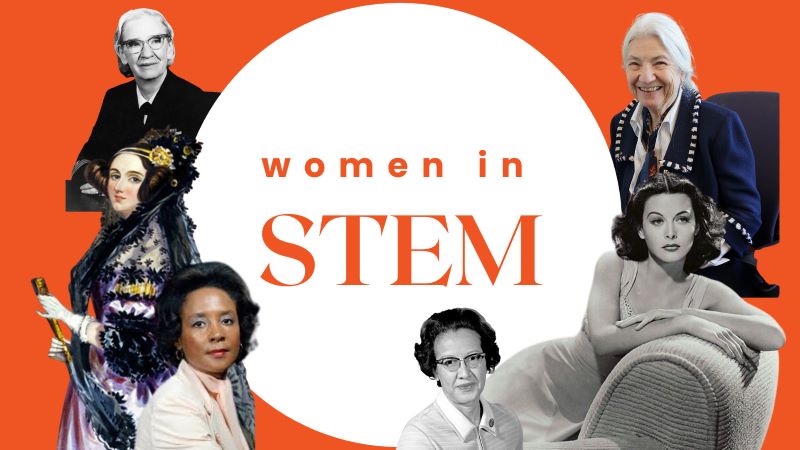
The history of technology often highlights a few famous inventors. Yet behind those stories are women whose ideas and persistence changed the world.
From the 19th century to today, these pioneers pushed the limits of science and society. They calculated paths that sent astronauts to the Moon, built the foundations of computer networks, and taught machines to see and think. Their work didn’t just influence technology — it transformed it.
Ada Lovelace

Ada Lovelace (1815–1852) is often called the world’s first computer programmer. The daughter of poet Lord Byron, she combined strong math skills with a creative imagination.
She worked with mathematician Charles Babbage on his design for the Analytical Engine — a mechanical computer that was never built. Lovelace translated an academic paper about the machine and added extensive notes, including what is now recognized as the first computer algorithm.
Lovelace also predicted that computers could do more than math. She imagined they could create music, art, and logic patterns — an early vision of modern computing.
Jean Bartik

Jean Bartik (1924–2011) was one of the six original programmers of ENIAC, the world’s first large-scale electronic computer. Recruited in 1945 to calculate artillery trajectories, she soon began programming the machine — without manuals or programming languages.
Bartik and her team developed techniques like subroutines and modular coding by manually wiring and switching components. Later, she helped convert ENIAC into a stored-program computer, paving the way for modern software design.
Her work helped shift computing from fixed hardware setups to flexible, general-purpose systems.
Hedy Lamarr

Hedy Lamarr (1914–2000) was a Hollywood actress and a brilliant inventor. During World War II, she and composer George Antheil designed a “secret communication system” that changed frequencies to prevent signal jamming.
Their 1942 patent wasn’t used during the war but later inspired key parts of modern wireless technology — including GPS, Bluetooth, and Wi-Fi.
Although she was once known mainly for her film career, Lamarr is now celebrated as a visionary who helped shape the way the world connects.
Doctor Grace Hopper

Grace Hopper (1906–1992) was a U.S. Navy rear admiral and one of the most influential figures in computer science. She helped program the Harvard Mark I and wrote its programming manual, documenting large-scale computing for the first time.
Hopper also created the first compiler, which translates human-readable code into machine language. Her work inspired COBOL, one of the first high-level programming languages.
She even coined the term “debugging” after removing a moth from a malfunctioning relay. Hopper’s belief that computing should be accessible to everyone helped democratize programming.
Katherine Johnson

Katherine Johnson (1918–2020) was a trailblazing African American mathematician whose calculations were vital to NASA’s space missions. Working in the segregated “West Computing” group, she performed complex trajectory calculations for the Mercury and Apollo programs.
When John Glenn prepared for his historic orbit, he trusted Johnson to verify the computer’s numbers manually. Her precision and insight were essential to the success of Apollo 11’s journey to the Moon.
Johnson’s brilliance helped break both racial and gender barriers in science.
Annie Easley

Annie Easley (1933–2011) was a computer scientist, mathematician, and rocket engineer at NASA. She began with manual calculations before moving into software development as computers became central to aerospace research.
She worked on the Centaur rocket stage and developed code for energy conversion and early hybrid vehicle technology. Easley was also a mentor and advocate for diversity in STEM, helping build a more inclusive NASA workforce.
Doctor Margaret Hamilton

Margaret Hamilton (born 1936) led the team that developed the Apollo mission flight software at MIT. As director of the Software Engineering Division, she created programs that allowed the Apollo Guidance Computer to handle errors and prioritize critical tasks.
During the Apollo 11 landing, her software helped prevent mission failure when the system overloaded. Her insistence on treating software as an engineering discipline established many of the principles used today in software development.
Radia Perlman

Radia Perlman (born 1951) is a computer scientist whose work forms the backbone of modern networking. At Digital Equipment Corporation, she invented the Spanning Tree Protocol (STP), which allows networks to expand while avoiding loops.
STP made Ethernet scalable and reliable, enabling the growth of today’s interconnected world. Often called the “Mother of the Internet,” Perlman also advanced network security and routing systems that keep data moving efficiently.
Professor Ruzena Bajcsy

Ruzena Bajcsy (born 1933) pioneered research in robotics, computer vision, and artificial intelligence. In the 1970s, she developed methods that help machines interpret their surroundings using sensors and adaptive algorithms.
Her work bridged mechanical systems and intelligent decision-making, laying the groundwork for modern robotics. As a professor and mentor, Bajcsy has inspired generations of engineers to push the boundaries of human–machine interaction.
Fei-Fei Li

Fei-Fei Li (born 1976) is a leading AI researcher known for her work in computer vision. She created ImageNet, a massive dataset that trained machines to recognize and understand images, fuelling breakthroughs in deep learning.
As co-director of Stanford’s Human-Centered AI Institute, Li promotes ethical and inclusive approaches to artificial intelligence. Her work continues to shape how society builds and applies AI technology.
The Legacy of Women in STEM
From Ada Lovelace’s early vision of computing to Grace Hopper’s compiler that made it accessible, from Hedy Lamarr’s wireless innovations to Katherine Johnson’s spaceflight calculations — these women built the foundations of the digital age.
Their achievements remind us that innovation thrives when diverse voices are heard. They didn’t just make technology better; they made it more human, creative, and inclusive.
Related Article: The Role of Managed IT Support for Business Success
Source:
https://www.salesforce.com/eu/blog/10-women-changed-tech-landscape-forever
https://intalio.com/blogs/10-women-who-changed-the-technology-world
https://www.newyorker.com/tech/annals-of-technology/ada-lovelace-the-first-tech-visionary
https://www.britannica.com/biography/Grace-Hopper
https://www.nasa.gov/people-of-nasa/katherine-g-johnson
https://www.nasa.gov/image-article/annie-easley-computer-scientist-mathematician-trailblazer/
https://www.nasa.gov/history/margaret-hamilton-apollo-software-engineer/
https://www.computerhistory.org/fellowawards/hall/radia-perlman/
https://www.nap.edu/read/25676/chapter/3
https://hai.stanford.edu/people/fei-fei-li